
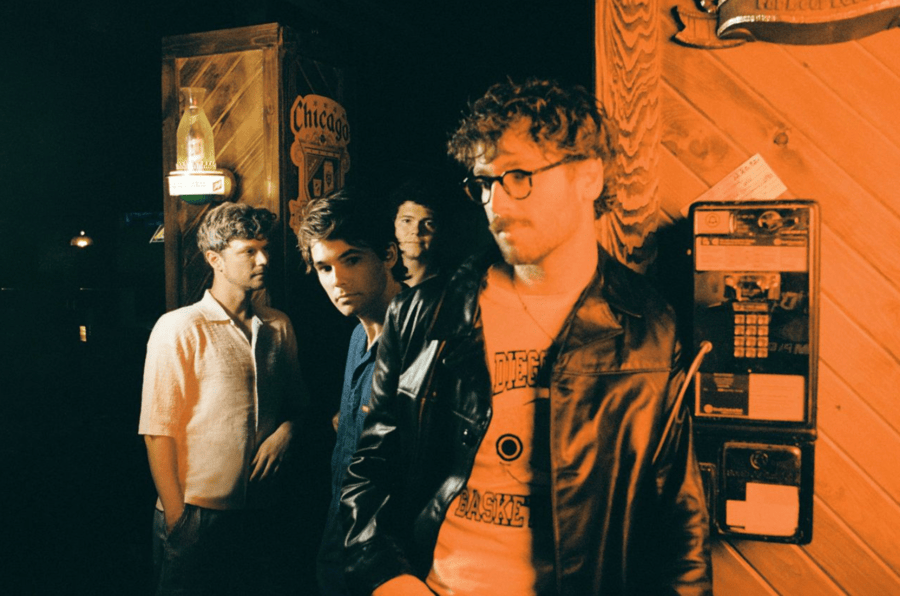
Earlier this year, The Brook & The Bluff released their fifth album, Werewolf, on Dualtone Records and subsequently toured in support of the album. While the first leg didn’t include a Columbus stop, with the release of a new EP, Lookout Pond, in September, the boys decided to hit the road again and bless us with a show taking place on Sunday evening at the A&R Music Bar.
In March, I had the chance to hop on a Zoom call with the band for BigTakeover.com. What follows is a shortened version of that conversation (read the entire thing here).
***********************************************
Every band will say their most recent album is the best in their catalog. Sometimes that’s true; other times bands are just trying to convince themselves. For Nashville’s The Brook & The Bluff, recording most of the album live in the same room for the first time — bouncing off each other’s energy, watching reactions in real time and responding — the idea that Werewolf is the crown jewel is an easy sell.
Having traveled down the folk-rock pathway in the past, this time around the band leaned into ’70s classic and Southern rock. While nothing on Werewolf sounds like Lynyrd Skynyrd or the Allman Brothers, the influence of artists like Tom Petty, Bob (and Jakob) Dylan, and the Eagles can be heard throughout the album’s ten tracks.
It’s a luxury to have an entire band join a call to talk about a new album, and I’m thankful that Joseph Settine (vocals/guitar), Alec Bolton (guitar), Kevin Canada (keyboards), and John Canada (drums) were able to offer their individual thoughts during this hour-long conversation. As we kicked things off, I checked in on something Settine told me when we spoke in 2023.
Werewolf being the album title and the first song, does that set a theme or is it just something that really worked as a title?
JOSEPH: Actually both. When we were talking about the sequencing, I was pretty adamant about “Werewolf” being number one and setting up the whole record — from it being a cool title, and from the lyrics of that song. I felt like it really distills the whole record into one thing. It’s such a good scene-setter. That song just feels like it really kicks it off, and it isn’t probably the most screaming song. It is definitely a rock and roll song and definitely has a nice, chunky groove to it. But you don’t start on 500 and have nowhere to go — whereas if you go in to “Get By,” there you are, ramped all the way up. So I think it’s a nice scene setter.
Do you consider this to be a series of short stories — an anthology — or is it sort of a complete story from start to end?
JOSEPH: Lyrically, it deals with some of the stuff I’ve always written about — just being generally anxious, generally kind of depressed. But I also went through a lot of life changes. I exited a really long-term relationship, and it was a little messy. There were things I regretted towards the end of it, and things both of us on both sides regretted. That’s a lot of the lyrical themes. But I actually think the theme of this album is more so about us as a group. What we were really trying to accomplish was to make an album that felt like one of our live sets and captured that energy because I feel like we’ve always felt that’s probably people’s favorite part of the Brook and the Bluff: coming to a live show and having that community experience, being in a room with a bunch of people getting to experience live music, which is one of the best things about being human. More than what I’m talking about lyrically, I think this album is more about the story of us as a group. We’re just some dudes sitting down playing songs together for the love of playing songs together.
ALEC: Getting back to our instincts, basically. Using our intuition. Instinct was a working title at one point, going with this general theme of, let’s get back to what we feel like we do best together, which is play music in a room and then really chase down the things that we naturally lean towards. Instinct and Werewolf and all that just had this general theme of being true to who you are as a person and as a band.
KEVIN: The title Werewolf fits more in line with the type of music on the album, because it kind of is just a rock and roll album at the end of the day. Werewolf paints a picture in your mind of something a little more gritty than Instinct. That’s kind of why we went that path with the name.
JOSEPH: I always felt like Instinct felt like an 80s synth-pop album for some reason. Which I wouldn’t complain about, but…
Was there a song on the album, or maybe one that didn’t make the record, that kicked off the process? Or did you pick a date and say, “We need to start writing on this day”?
JOSEPH: Some kind of combination of all of it. I feel like there was one day in June of 2024 where Alec and I were like, “what do you got?” and we wanted to sit down and really start being intentional about the album. I had started “Baby Blue” before that, but it wasn’t really a part of that day. The day we got together, I had written “Can’t Figure It Out” over the weekend, so those were kind of the two I brought. Alec was playing around with the riff of “Moving Along,” and we immediately sat down and started jamming on that. It was like, oh, this feels like it would be the outro, the last track of an album. Then I played “Can’t Figure It Out,” and I had just written it maybe a few days earlier. I was like, “I think this is the best chorus I’ve ever written. I think this could be a huge single.”
And then towards the end of that same day, Alec just started playing the “Werewolf” riff, and I started humming the melody, had that first line there, and we kind of hammered out the rest of that song. Those were just kind of the nucleus of what would become Werewolf the album.
ALEC: What I remember most about that day is just playing. “Moving Along” and “Werewolf” kind of came out, and we were like, “we don’t know what these are yet, but they’re so much fun to play together.” That felt important, walking away thinking, “I cannot wait to play these again”.
JOSEPH: We’ve been listening to a bunch of classic rock on the road, crushing CCR, always inspired by the Beatles, starting to listen to Little Feat. And then the idea of, what is our purest distillation as the Brook and the Bluff as a band? I think this is what happened.
You recorded mostly live, all of you in the same room at the same time? Is that the first time you’ve done it that way?
JOSEPH: Yes, actually. Since the first EP, or since Masks, I guess. We were laying stuff down, drum and bass, then go over with guitar. The vocals, we would go back and put on over the top. But everything else, it’s the vibe of us just going from start to finish. There are some layered guitars in “Super Bowl Sunday” and a few other songs where it needed to just get bigger. But for the most part, the bones of all the tracks are us just playing. We would do four or five takes and pick the best one.
ALEC: The connection in the room, in the moment, we were all looking at each other, listening to each other. There’s a synergy there that you just can’t recreate stacking stuff.
I’ve been interviewing bands since 1991, and I have never had a band say their new record is not the best thing they’ve ever done. So sell me on why this is the best thing you’ve ever done.
KEVIN: We’ve gotten feedback from fans that they love seeing us live because there’s just an extra element of energy to the performances. Since we really took that into the studio with us, all in the same room, locked in together, there is an extra element of elevation when you’re playing at the same time. We rehearsed these songs for a month and a half, maybe two months before we even got into the studio, so we were all familiar with the arrangements. It was almost muscle memory at that point, so we really got to just relax and not overthink anything. We were able to release and really form that connection in the studio, get into that headspace of being in front of a live audience. I think that took the energy to the next level.
ALEC: This is the most fun I’ve ever had recording. And I think it allowed us to utilize our strengths and express ourselves in the most complete way. We took everything we’ve learned in the last 10 years and put it towards making a record.
In 10 or 20 years, do you think there’s going to be one of your records that people are going to be demanding you go out and play?
JOSEPH: Probably this one or First Place. First Place is still very beloved among our fans. But with every album we’ve gotten a little bit more people, and this is the one we’re putting out with the most people that are interested, that are fans, that want to hear it. When I listen to it, I hear the most of us as a group, the level of collaboration, everyone kind of moving on this one vision for the whole record. I think you can always kind of tell when an artist gets to that point. Some bands and some artists are there from day one, but I think on this one we’ve grown up a little bit. We’ve all been able to settle into ourselves as adults, and I think that has really influenced what came out on the record. This is the truest expression of us as a group that we’ve had so far.
This album has a different energy than others in your catalog, and I appreciate that you haven’t just settled into, “last thing worked, let’s do it again”. Are you always trying to push yourself to try something different.
JOSEPH: Definitely always trying to push. And also, I think I’m too scatterbrained to be obsessed with one thing for longer than one record cycle. I think about all of our albums — First Place is very influenced by R&B, Frank Ocean, Bon Iver, that whole world. Then Yard Sale was Laurel Canyon, the Beatles, that kind of thing. And Bluebeard was this whole other thing, “we’re gonna make this record in the mountains,” and that is what happened. We’ve just been kind of pulled along by different things that are interesting to us at the time. But it always ends up being unique to us. It still always feels like the Brook and the Bluff.
Have you ever played a club where the power goes out? “Baby Blue” sounds to me like something you could pull off if the power went out. You guys could just sing it and play with an acoustic. It sounds great as a full thing, but it also sounds like when you get invited to a local radio station and you just bring an acoustic guitar. That song sells itself without needing anything extra. Was it written to be played that way?
JOSEPH: Yeah, for sure. When I was writing it and we were working on it, I brought it to everybody and said, “I’m working on this verse thing” — I had most of it — “but the whole idea is that we’ll sing three-part harmony for essentially the entire song”. Eventually I wrote the bridge, and I was like, “okay, not the bridge, but there is harmony in the bridge too, just not on the melody line”. The idea for that one was always pretty crystal clear. It’s like, what’s a song where we’ve never done this before, we’ve never sung three-part harmony through the verses before. Let’s do it.
Another song like that is “I’ll Have It Down”. It reminds me a little bit of the Eagles. There’s a multi-part harmony that I attribute to the Eagles kind of sound. I’m not going to confuse you with the Eagles, but that’s sort of what I hear when you all sing together.
JOHN: The Eagles were definitely an inspiration, for sure. We definitely reference them as a model of the kind of band we want to be.
ALEC: In the way they took such pride in how well they sang together. They’re a beacon of, like, who’s a band that really cares about the harmonies and singing together? They’re just a gold standard.
“105” is just a great driving song, and I think that’s probably what the song’s about. The intent is just, get in the car and cruise.
JOSEPH: Get yourself a speeding ticket.
ALEC: Away from all your problems. But also straight towards them.
“Gone for the Weekend,” guitar-wise, has a Tom Petty, Mike Campbell kind of thing going on.
JOSEPH: Tom Petty was huge for us across the whole record.
You mentioned CCR and Little Feat earlier, and hearing all these comparisons, it feels like that classic rock influence really informed how these songs were written.
JOSEPH: Yeah, a thousand percent. It was twofold. What feels like the most us right now, and what songs are going to be the most fun to play? And then there was this element of, “wow, nobody has” — at least we couldn’t think of anyone who had — “made an album like this in a while. A true rock and roll record.” Ours is probably more folk rock and roll, it’s got a little more of a folk bent to it. But we were also just asking: when is the last time you heard a record that reminded you of Creedence Clearwater Revival that was released in 2025 or 2026? We were kind of looking at it and being like, maybe there should be a band that is like that. And for me, as a songwriter, the older I’ve gotten, I like what I like and I’ve also gotten more comfortable with being a little more Southern. We all just kind of embraced all of those things about this record, and this is what came out.
ALEC: It kind of goes back to the Werewolf theme of, this is who we are, unfiltered. There is no good and bad, it’s just us.
JOSEPH: Little Feat, I will say, is the most underrated band of all time. I’ve planted my flag on that take, and I will die with my flag planted there. They are an incredible, incredible band.
KEVIN: They just get better the more you listen to them. I really just got into them in the last couple years and it’s mind-blowing. Particularly their first five or six albums, when they had Lowell George as their front man. Those are all so incredible.


