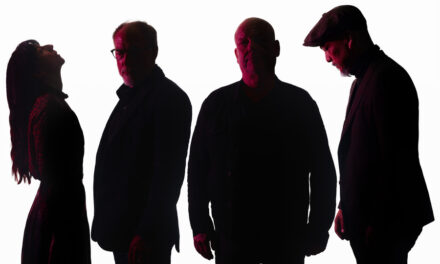
Photo: Ben Newman
Nanocluster – a collaboration between Immersion and SUSS perform on Wednesday, March 26 at The Old First Presbyterian Church, 1101 Bryden Road, Columbus, OH 43205. Doors open at 7pm, music starts at 8pm. Tickets are $25 in advance and at the door. You can purchase tickets online here: https://thefusefactory.org/event/performance-nanocluster-immersion-suss/
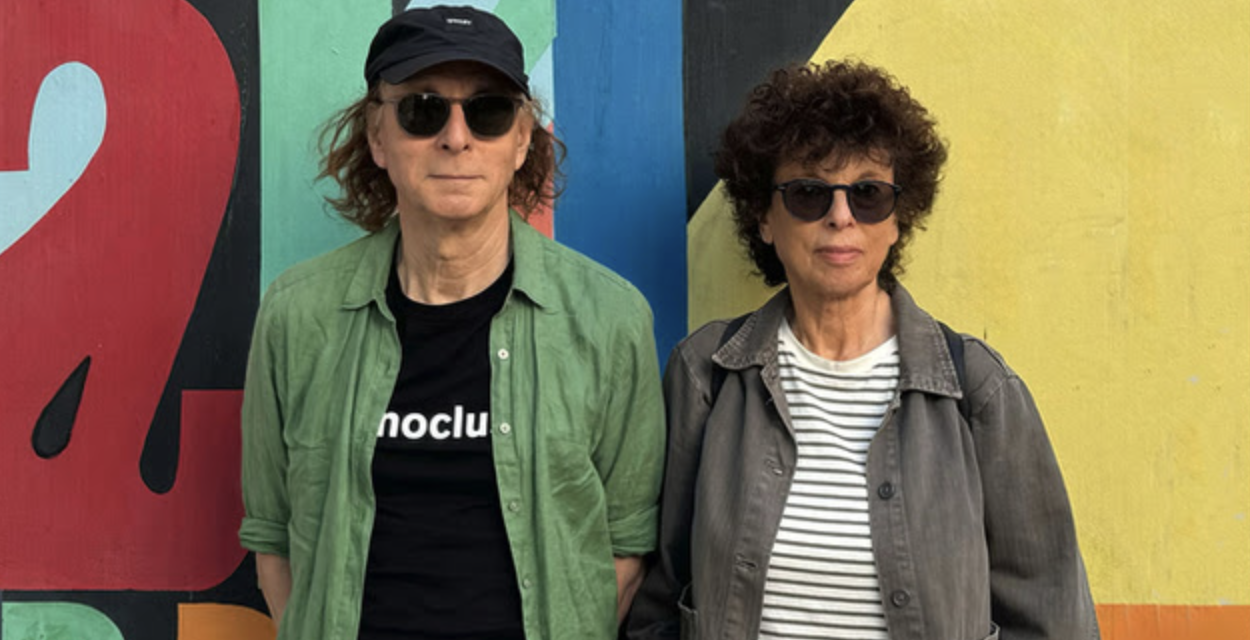
In the early ’90s, Colin Newman (Wire) and his musical partner/wife Malka Spigel began creating ambient music under the name Immersion. In the early 2020’s, Immersion began collaborating with like-minded artists on a series called Nanocluster. The third Nanocluster volume was released earlier this year and features Newman and Spigel working with SUSS, an instrumental ambient county trio out of New York City and featuring Pat Irwin, former B-52s bass player and soundtrack composer of TV series like Dexter.
Immersion and SUSS met in person for the first time just a few weeks ago to rehearse for SXSW dates in Austin. With those out of the way, the Nanocluster tour is now fully underway and stops in Columbus on Wednesday night where both Immersion and SUSS will play their own set before joining the stage together to close out the evening.
Newman and Spigel recently joined me from their home in the UK to discuss working with SUSS and what people can expect from this week’s performance.
How does songwriting for Immersion compare to songwriting for Wire? Is it more improvisational or is it more structured?
Colin: Immersion is a collaboration between us. With Wire, I tend to write songs and then bring them to the band, and then they learn them. It’s a very different process. It’s not like I tell them exactly what to play; but I tell them this is the chord sequence, this is the tempo, this is how the tune goes with it. It is a basic scheme for the piece.
Malka: With Immersion, we start normally with the music. The song gets inspired by the music we create. And then the song is born out of creating something together.
Colin: When we started as Immersion, it was pretty much ambience with rhythm. By the end of the ’90s, it was completely ambient and abstract and instrumental.
Malka: We came from backgrounds of being in bands, and we were fascinated by techno and drum and bass, all this music that didn’t rely on personalities and image. We were like, “Yeah, we like that.” And then we love the music, obviously. So we kind of got into it.
Colin: Immersion, in a way, comes from DJ culture. That’s where our roots as a partnership lie, but also in our own interaction together. We’re a couple. We work together intensely. We’re partners on many different levels and it’s very organic.
Malka: We love good songs. It’s something that we miss a bit when we do a lot of instrumentals. It’s great to bring songs into it as well.
Colin: That’s something that’s come back into motion with Nanocluster. There’s more Immersion material coming later this year and that does include songs. In a way, we’re influenced by the people that we’ve collaborated with and taking the thing into their direction. It’s not all songs, some of it’s instrumental. I think everything is in this continuous state of evolving and that’s kind of how it should be.
Malka: And we don’t really have rules. It means that if a song comes out, and it’s good, then great. Obviously, you want an album to be coherent.
Colin: The coherence, in a way, comes from the people who made it. It’s the same people doing it, however diverse their set of approaches are, there’s an inevitability.
Malka: It’s even more important with collaboration, like with SUSS, that we try and pull it all into one album.
I discovered SUSS a couple of years ago. I love Americana music and pedal steel and slide guitars. I also love shoegaze music. I was trying to find any artists who might mix Americana with shoegaze on Google and I came across SUSS. I thought, “This is what I’ve been looking for.” I had the chance to talk with them and I really enjoyed the conversation because they aren’t just some young kids. They’ve got decades of musical experience. How did you come across the band and their music and how did the collaboration happen?
Malka: Both them and us are not young, been around, did a lot, but we have a fresh approach to what we do. When we first heard SUSS, we had a similar reaction to you. But we were not searching, we just heard it. And I thought, “Wow, that’s so cool.” I thought it was a younger band, somebody new that came up with this amazing sound. When we looked up and realized they were people been around for a while, but they have this beautiful, fresh, sounding music. Although it there’s a lot of obvious influences, it’s original, the combination of the the styles.
Colin: The context is that we’ve been doing a radio show for the past 5 years, every week, two hours. Malka especially, is very, very good at finding new music. I think anyone who’s done a radio show would, I imagine, be good at finding music. If you say to someone who’s never done one, they’ll say, “Oh, yeah, I know loads of music.” Give them 2 weeks because you’re gonna need to start finding something new because your record collection will start to sound stale. We didn’t set out to play new music, but it became inevitable. So what we were about was discovering new music.
Malka: And it feeds into our creative approach, because we hear a lot of new stuff and get excited. It’s inspiring for us.
Colin: Malka found SUSS and we were like, “Wow! This is amazing.” It’s what they describe as ambient country. That’s what it says on the tin. It is exactly that.
So you discovered them when you played them on a radio show but when did you have the idea to work on something with them? Did you work on this stuff with them in mind, or did you already have stuff?
Malka: It doesn’t work like that. When we work with other people, we have to create it together.
Colin: We’ve been playing them for maybe 2 years on our show. We’ve had the show since 2020, and probably started playing them in 2021 or something like that. We post the show on social media every every week, we tag all the artists, and sometimes a lot of artists don’t notice. But then you suddenly people get in touch. “Awesome. You played my track,” and that sometimes results in a conversation. And the conversation that resulted was Bob Holmes also has a radio show that he describes a podcast, but it is really a radio show, called, as you might expect, Ambient Country. He asked us to be guests on it, having realized that we’re playing their material.
Malka: He asked you to pick some music and play it on his show and we talk about it. We got on really well.
Colin: At the end of the conversation, we were just chatting, the recording was finished. And we said, “We do this collaborative project, Nanocluster.” We’re always talking to different artists about it. There’s always somebody in the pipeline that we’re talking to. We weren’t sure if that conversation would go anywhere. And then they came back and said, “We’re interested in this. This sounds like fun.”
Malka: It’s obviously a risk, because you have no idea if you’ll find a common language. The way we do it is we exchange a little bit of music. We send. They send it back and build on top of it. Music is a language, and to put it into words is hard. How do you communicate? How do you do it? But it seemed to work every time we’ve done it.
It was all exchanging files back and forth? You never got together?
Colin: We’ve never met them. We’re probably gonna meet them for the first time on Thursday night,
Malka: We saw them on zoom. As you get to know people online, you feel like you know them. But it’s not the same.
Colin: This will be another voyage of discovery. We are naturally both risk takers. It’s the idea of getting into some kind of working relationship with people that you’ve never met, to do something on another continent.
Malka: Sometimes it’s a very young band or musician, sometimes it’s very experienced established artists like SUSS. It’s a challenge.
Do you think there will be a point during your first show with them where you’ll get caught up in how well the collaboration is working and look at each other, smile, and think, “This is how we envisioned it was going to be”?
Colin: We don’t plan stuff like that (laughs). Both Malka and I tend to be people who have got too many other things to worry about. I think maybe five shows in we might start to relax a little bit. The whole Nanocluster thing is three sets. There are three sets every night. There will be a set from Immersion. There will be a set from SUSS. There’ll be a Nanocluster set.
Malka: The album is an unknown that we went into, and it’s very rewarding, it worked well. Now we have the next stage, the live thing which we’re going into. We’ll find out.
Colin: We’re doing it very much the way we’ve done other Nanoclusters, which is pretty much how we do Immersion live. We know we have a certain amount of backstop. If you were to try to recreate this music, you would need a much bigger band. There’s only 5 people on stage so we’ve got to figure this out. It will be kind of interesting. We are coming from a very different place from them in terms of where where we are as a live entity, where they are. Even though they use a lot of that methodology of looping and stuff like that, they’re still very much in that Americana, pure playing kind of thing, whereas we are really much more like electronic musicians.
In Columbus, you’re playing in a church. That seems ideal for what you’re doing. You don’t want to be playing in a rock club where everyone’s holding their drinks, arms crossed, and up front just staring at you. It feels like this show is going to be an experience. Are you trying to mostly play in non-traditional venues?
Colin: It’s quite mixed, but we aimed for that. All of the other Nanoclusters that we’ve done, we’ve done the performance first and the record afterwards, which, in terms of marketing, is the absolute worst way to do it. By the time the record comes out, you’ve already done the performance, and the artist is already off on their own tour. So we did it this way because we wanted to do an actual tour. The idea of it is a proof of concept. If we can do a tour of America with a band. and we can make that work with an album coming out before the tour, we could literally do it with anyone, anywhere because that starts to become a thing in the world. The idea was, how are we gonna make this so that there’s no expectation of it being a rock gig. So, let’s look at the venues and try and choose places that are going to be more conducive to the idea that this is kind of an art experience. But they are quite mixed. We’re playing Johnny Brenda’s in Philadelphia. In the end, it’s where you can get booked. But that was the original idea.
Each of you will do your own set, and then you’ll do the collaboration thing. What does the setup look like for the two of you?
Colin: Malka plays and MS10.
Malka: Which is a a analog synth.
Colin: I play keyboards and guitar. We sing and we use machines to run the show. We have visuals.
This kind of music lends itself to visuals. When people are watching, is the focus on the two of you, or is it on the visuals?
Colin and Malka: On the visuals.
Colin: We don’t really tend to light us. We tend to just have the screen behind.
Malka: Some people have patterns, and it can get boring. From us, it’s real footage. There’s a story somehow.
Colin: It’s not synced. We didn’t get to that point yet. I think that’s the next stage of our evolution to actually sync the video.
Malka: It syncs naturally.
Colin: If you’ve ever seen any Immersion video or any Nanocluster video, you know what kind of thing is in those sequences. It’s not a million miles from that. We’re providing atmosphere with the visuals. There’s stuff going on in the videos for people to watch. We’re boring. Immersion is not a ‘look at me’ type of thing, anyway.
Well, I’m excited to check you out when you’re in Columbus. I think it’s cool that your fans are going to discover SUSS and SUSS fans are going to discover Immersion through this collaboration.
Colin: The industry would like to have us all competing with each other. Actually, we don’t need to be doing that. We need to be encouraging people to listen to other people’s music. That’s why we play a lot of other people’s music on our show because it’s not about us. It’s about the other people. It’s about empowering.
Malka: It’s about sharing what we discover with other people.