
In 2002, Star Wars Episode II: Attack of the Clones released in theaters. Despite negative reactions from pockets of Star Wars fans, the film garnered worldwide success. It made over $650 million dollars at the box office, and that does not include sales of toys and other merchandise. The studio spent $115 million dollars on CGI effects, A-list talent and wardrobes only limited by the imagination. When it came to the watercraft though, the creators gave their creativity some time off.
“It’s the worst designed thing in Star Wars ever,” West Taylor told Columbus Calling. “It’s a canoe, and it has Styrofoam just glued to it, and it’s painted yellow and blue or something. Why do you have a boat? I don’t know the purpose of having a boat in the Star Wars universe.”
13 years after that glorified gondola successfully carried Natalie Portman and Hayden Christensen to safety from the a slew of bounty hunters, songwriter, musician and producer West Taylor used it as name inspiration for Space Canoe Records.
The almost nine-year old label unfortunately does not represent Mos Eisley cantina tribute bands, but it is on the forefront of country and midwestern music in Columbus.
A Drum Kit for Christmas
Taylor grew up in a musically-inclined family. His dad played guitar when he was young, while his mom not only did that but also played the piano, and some flute in high school marching band. Family legend has it that while his great great grandfather met and played with Earl Scruggs, a legendary American musician famous for three-finger banjo playing, also known as “Scruggs style,” while his ancestor was hopping trains to find work in the 1930s.
“He had this small recording device that he could record on. In the family, they’re swearing, ‘oh, he met Earl Scruggs when he was in his early 20s, and recorded his three finger style banjo playing,’” Taylor said. “No one can find the recordings, but I do have recordings of him singing, which is really cool.”
As a child, Taylor does not remember his parents playing any instruments, but knows how involved his parents were in the local church choir. He watched his parents sing on stage until he was old enough to be recruited into the choir himself. Formative moments of seeing people he knew standing in front of an audience and performing. It normalized something that a lot of people fear. They were formative moments in the life of the record company’s founder.
When the family was not providing the soundtrack for the pulpit, they listened to country music. The same kind Taylor grew up listening to with the generations that came before him in Mt. Sterling, Ohio. It was music built on stories relatable to Taylor and his family’s Appalachian upbringing.
Even though the town of less than 2,000 people is within an hours drive of the capital city, Mt. Sterling could not be further away. Taylor grew up surrounded by the farms once run by his grandfather and his siblings. During the 1980s, his great uncle Dick Dailey started the Family Farm Movement to contend against skyrocketing interest rates. At the time, banks took back machinery and foreclosed on farms regularly.
The Family Farm Movement was political, but it also literally stood up for farms that banks tried to foreclose. On one occasion, the group held a vigil and protest overnight behind a loan office to push for a renegotiated loan to avoid foreclosure. On another occasion, a group of over 20 people also filed into a sheriff’s office to demand to speak with a farmer who the authorities arrested for taking back his 33,000 bushels of soybeans out of a bankrupt grain elevator, now owned by the bank.
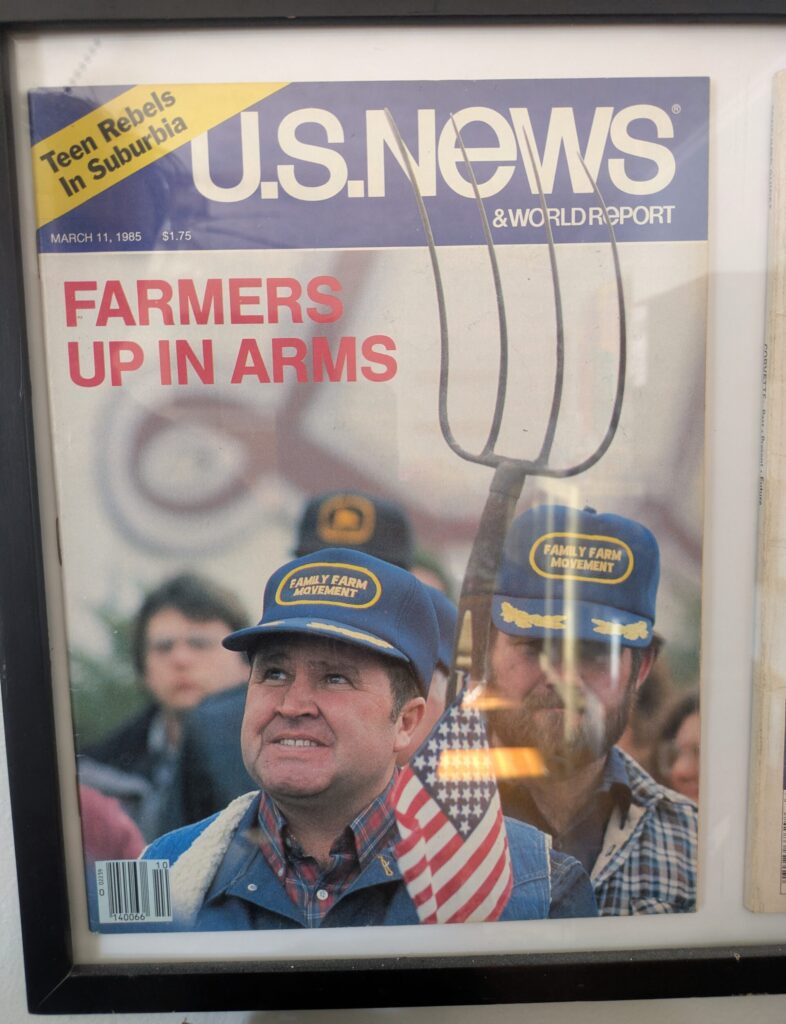
U.S. News magazine cover from March 11, 1985, featuring founder Dick Dailey, West Taylor’s great uncle. Photo by West Taylor.
While the movement was not successful enough to stop the crash of farming in the United States, the stories lived on through the generations that followed. It is part of the storytelling that is the foundation of country music, and is part of the family legacy. Every performer has an origin story for how they got into music. For Taylor, it was not his parents singing to the congregation necessarily. There was a more direct route from spectator to musician.
On Christmas Day, the then-five-year old Taylor opened up a gift — a drum kit. It was not something on the kindergartener’s letter to Santa Clause, but it was on his 13-year old guitar-playing oldest brother’s list. That same year, Taylor’s nine-year old brother received a bass guitar.
“He forced us into it,” Taylor said. “And my parents? Yeah, they went along with it. They put up with the drums in the basement.”
With those somewhat unwanted gifts came the formation of a family band. Taylor kept with it and that forced recruitment into music turned into a passion. Over the years, Taylor’s focus shifted and he played the drums on pop and rock records, and even had a phase where he was all in on punk music, but the songs and stories of his childhood never went away.
Taylor still remembered watching his grandmother sing, or the congregation’s bluegrass band play, at a weekly music showcase at the local Southern Baptist Church. Then there were all the cowboys Taylor watched sing on television alongside his grandpa. That connection to country music was unbreakable.
“I just always reverted back, and I always came back to it,” Taylor said. “This is what comes naturally. And I don’t feel like I’m I don’t feel like I have to try as hard, which is great, because it’s hard enough.”
Heading Up 71
As a high school student, Taylor still played with his brothers, including shows at bars when he was still years away from legally drinking most of what they sold. After graduation, Taylor accumulated recordings of his work and he needed a way to easily share it with people as almost a digital resume. That is how Space Canoe Records began.
Like many Country artists, the pull to Nashville, Tennessee called to the Ohioan, where his oldest brother eventually landed, but not for music. “I say he works for the CIA. I don’t know what he does, some sort of economics tank thing.” However, Taylor had an epiphany in all of his travels down south.
“I was spending time down there, and then I realized it’s six hours away. It’s not that bad,” Taylor said. “Chicago is the other way, and New York’s not that bad.”
Outside of Nashville, Chicago and New York, there are major cities within 3-4 hours in every direction. Indianapolis, Detroit, Pittsburgh, Louisville, Cleveland, and Cincinnati, to name a few. Columbus provided a central location and home base for a lot of people who were not born in or around its city limits, and as most residents in Central Ohio can attest.
A city of transplants has its ups and downs. It brings together diverse groups of people from all backgrounds. The old adage of the American melting pot. All good things, but because of that it is also a blank canvas of sorts. When people arrive from out of town and try to get engrained in it, they quickly see that it is also a city of individuals. People make Columbus what they want it to be.
Musically, Columbus is known for national acts like Twenty-One Pilots and Caamp, but then there are small pockets of local music that really bleed into one another. Any of the small independent venues in the city can host any genre on any given night. While Dirty Dungarees in Old North is the home of hardcore music in the city, non-hardcore bands play within its sticker-laden walls. Rumba Cafe hosts everything from folk to punk to country.
“Every year has been different and I’ve been lucky to travel around a lot and play all over the place,” Taylor said. “And there’s not a lot of cities that has, what feels like in Columbus, an artist built community that’s really feeding itself well.”
Before Space Canoe took off as a record label with other artists, Taylor studied at RecW, a renowned audio recording and production school in Masseyville, Ohio, less than an hour south of Columbus. Down near Chillicothe, Taylor was stuck inside a cabin thanks to a snow storm that helped rip the axle off of his car. With no easy way of leaving, Taylor went from creating music to learning how to effectively put it all together. When he left, he learned enough to try his hand at becoming part of that music community.
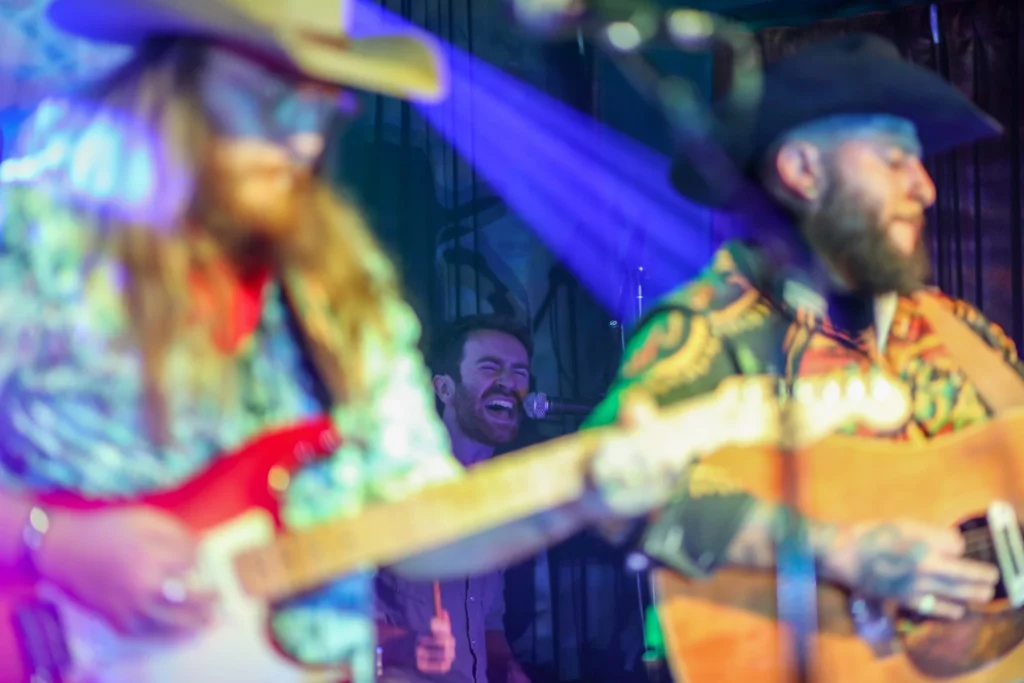
West Taylor singing while playing the drums at one of Space Canoe Recrods’ “Cosmic Honky Tonk” events. Photo from Space Canoe Records.
Even though many people outside of Columbus see it as a cowtown or flyover city. It sticks out from the rural landscape that surrounds it. Outside of lightly-themed country bars near downtown or a professional bull riding restaurant in Easton, there is not much “country” aesthetic around the city. Also, none of the places mentioned above are highlighting storytelling country artists who want to get on a stage and play for likeminded individuals. The best place to do that is the Rambling House.
Country and folk music was Taylor’s passion, and Rambling House is where he found his people. Space Canoe Records went from a personal catalog to a local outlet for recording. From 2018 to 2022, it put out four full-length albums and a single. Only one of those tracks was his own, the 2020 single “Someday.”
Space Canoe
When people think of a record label, they think of a business with a soul purpose of churning out music to generate sales. Calling Space Canoe a label, in that respect, does not paint the entire picture. In nine years, Space Canoe Records released eight full albums, and numerous EPs and singles, for nine different artists, Taylor included, but the outfit is part experiment and part collective.
First is recording the music. Taylor found artists, and had artists find him, over the years to join the label’s catalog. The founder used a home studio and leveraged multiple recording spaces in and around the city. Oranjudio in Grandview is a label favorite. For Taylor’s solo 2024 solo album “Available Parts,” he spent most of his time playing it at Earthwork Recording Studio just east of Columbus, in Newark.
Experimenting does not mean using different buildings, but the means in which Taylor and partnering producers capture the sound. Sometimes the band plays the song live in studio, with only a pair of headphones, microphones and the instruments themselves. Other times its with no headphones at all, which requires the musician to balance their sound somewhere between not too loud and not too quiet.
He does not record it all himself but leverages other people in the community, like label artist and engineer Alex Estrada, who Taylor called an “incredible engineer and mixer and pedal steel player and banjo player, guitar player.”
Taylor is always willing to try something new to get the right sound for a project. Take his own for instance. To start the year, Taylor began recording his second full-length LP in an interesting way.
“For the first time, I’m taking my gear and I’m taking it to a hunting cabin, and we’re just kind of record it there and figure it out,” Taylor said. “Digging into limitations too is cool. It doesn’t have to be an expensive thing, especially if you have the people in the community to back you up and help you out.”
The growth of the community through music is where the collective comes in. Taylor does not any percentage from sales of the music.
“I’ve run into that myself as a solo artist and it drove me nuts,” Taylor said. “I tried to look at what a record label could be in modern times, and its organization and support.”
Space Canoe wants musicians to get their music out into the world, but also help those same people follow their own ambitions to be part of the local community. A recent example of that support is with singer and songwriter Moe Reen. The rising country artist moved from Chicago to Columbus after they gained popularity online with their music. Reen sought out Taylor and Space Canoe Records to capitalize on more ears listening to their music. That work turned into the 2024 EP release “Grow Again.”
From first contact between the two through the EP’s completion, it was only three to four months. One year later came the full length LP “Scribbled Line,” which included Taylor on the drums and seven other local musicians over multiple recording sessions. All adding to the project and the continued extension of the Columbus country community. In late 2025, “Scribbled Line” became the label’s first vinyl release.
Since the Taylor and Reen met in 2024, they played live in Columbus and toured together. The two filled up a car and played a lineup of shows over two weeks that started and ended in Columbus. In-between, they traveled as far west as Wyoming and swung back around through Tennessee, and they played all sorts of venues and environments. It also included chats with country music fans about being in the business.

Photo of Moe Reen (left) and West Taylor (right) singing together, from West Taylor on Instagram @Wyld_west
Outside of touring and creating music, Taylor also worked with Reen on building their own knowledge of the recording process. That is where more of the collective vision of Space Canoe Records enters the picture. Taylor wants to equip artists to know how to create and share their own work.
“That’s something they want to do is like to be able to and they do some self recording, but like getting into the fundamentals of different polar patterns and all this sort of stuff, giving people those tools to do it themselves is super important to me.”
Traveling Bard
On Sept. 30, 2025, the Rambling House announced its sudden closing. A day that did not make Taylor panic, but made him more sad than anything. After all, Taylor not only frequented the venue as an artist and lover of country, folk and bluegrass music, but he worked there as a sound engineer for years before it closed.
“It was the first place in Columbus where I felt like, these are people that love bluegrass music and folk music and country music,” Taylor said. “You know, I was like, ‘if it closes, well, that’s that chapter.’ And I skipped the denial part, and I went right to as acceptance, I guess.”
The collective mourning in the city’s country music scene did not last long. New owners revived the venue that is back to a thriving space for fans of the genre, but for a short period of time, it felt like the end of the one true spot in the city for people who love the storytelling aspects of country and all its sub-genres.
That building on Hudson Street was more than a few walls to put on shows, it was a space for the community to come together. A community that has grown over the years Taylor has spent in Columbus.
“It feels organic, which is nice. It doesn’t feel like anything’s being forced. The last three or four years have been a huge change from what it used to be,” Taylor said “It’s finally starting to be more of what I envisioned it being. And it’s more work, which is a change, because I’m usually juggling now, as opposed to one thing or maybe two things, I’m juggling four or five, and on top of that, doing booking and all that. It’s evolved.”
A recent revival of the more traditional roots of country music, often labeled Americana to avoid confusion with what is now considered country on the radio, is because an influx of new fans. Buckeye Country Superfest, the annual country concert at Ohio State’s Ohio Stadium, used to headline acts like Luke Combs and Keith Urban and now feature Americana stars like Tyler Childers and Sierra Ferrel. The popularity of the genre has even spurred on country albums from acts in other genres like Beyonce and Post Malone.
On a smaller scale, in rooms with a 100-person cap over a stadium with over 100,000, some of those same people are part of Columbus’ country music growth, on the most organic level where Space Canoe Records operates.
However, part of that growth is not only people finding the genre for the first time but people that move out of rural areas of the state to live in Columbus. They are listening and sharing their own stories through Taylor and Space Canoe Records.
“It’s stories of wherever you’re from,” Taylor said. “Where you’re from is an important piece of country music because you’re sharing your location with other people. Sort of a bardish thing, I guess, but it is growing. I feel like we’re getting more and more folks regionally. We’re placed in such a great location.”
To see West Taylor, Moe Reen and Space Canoe Records artists in action, the Rambling House hosts many of the acts’ concerts. On March 13, 2026, Taylor and Reen perform with a full band at the venue. Head to Rambling House’s website to see all the upcoming events.


