
When the word Mennonite comes to mind, it might elicit thoughts of rolling farmland or a pious religious community partially removed from the rest of society. It is not a group to the extreme of the Amish, but sometimes they are loosely lumped together. At least that was my understanding when I integrated myself into a friend group, where I eventually met my wife, in a town practically run by Mennonite families. It is quiet and clean. On the last day of school each year, kids drive tractors and lawn mowers to school. Check voter turnout data and it is a firm hue of red. In that area, Pride events are not the norm. That stereotype is what I took into the Columbus Mennonite Church on Thursday night. That is where Contrary Motion challenged my own beliefs and, much more importantly, the stereotypes of queer music.
Tucked behind businesses on North High is the Columbus Mennonite Church. You may have driven past the brick facade countless times without knowing its there, instead maybe looking at Katalina’s across the street and trying your best to scope out a parking spot. As you walk towards the church entrance, the sidewalk is surrounded by plants and flowers that are as inviting as the people who call the congregation home. I looked over at my wife and quietly mentioned a restroom and immediately a friendly face pointed them out from 10 feet away.
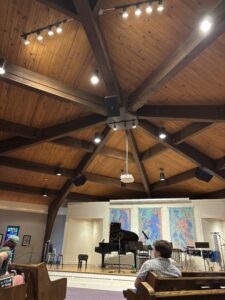
The sanctuary itself is nonconventional. Wooden pews that fill in half of the floor plan are not all directed point blank at the stage like most churches. Instead, the angle of the of seating in the octagonal shaped room invites community where you can simultaneously see the pulpit and the people sharing that space. On Thursday, people from all different communities occupied the seats for a night of experimental music by queer composers, and it was the perfect space for it.
Contrary Motion is not a band. It is, in their own words, a celebration of contemporary chamber music by Queer composers. The group’s mission statement is more of a question. “What does Queer sound like?”
Co-directed by percussionist Noah Demland and cellist Dr. Sam Johnson, Contrary Motion filled different spaces around the capital city over its now three years of existence. In 2024, they played the Ohio State’s downtown Urban Art Space. In 2025 it was Wild Goose Creative, just across the river in Franklinton. Occupying the Columbus Mennonite Church on Wednesday and Thursday, Contrary Motion’s program is as diverse as the spaces its filled.
Each year, the group of artists commission works from current Queer composers and place them alongside works from artists who are no longer with us. From those passed like Julius Eastman, Pauline Oliveros and John Cage to current Ohio area composers and 2026 was no exception. Contrary Motion’s program this year centered historically around Lou Harrison’s “Rhymes With Silver,” a 12-piece work that can go in any order, with nine chosen for the performance.
Before any music, Johnson, who co-emceed the event with Demland, let everyone know the program did not have any stifling rules normally associated with chamber or orchestra music. Concertgoers were encouraged to walk around, hear the music from different angles and be comfortable enough to do whatever they wanted, as long as they did not disrupt the enjoyment for others in the crowd. Most stayed stationary, one person knit and a few shuffled around in the hour and a half performance, but the music grabbed and held onto the collective attention.
Contrary Motion started with “within stillness: iv. color theory” by composer and flute player Zachery Meier. Commissioned for the event, Meier’s composition was one song covering all eight colors of the Glibert Baker’s original pride flag design from 1977. It covers the spectrum of human connection, intimacy, nature, art and healing over a relatively short period of time. Keeping track of the minutes is tough because the music itself takes over the brain. The seconds and minutes kind of float by the listener.
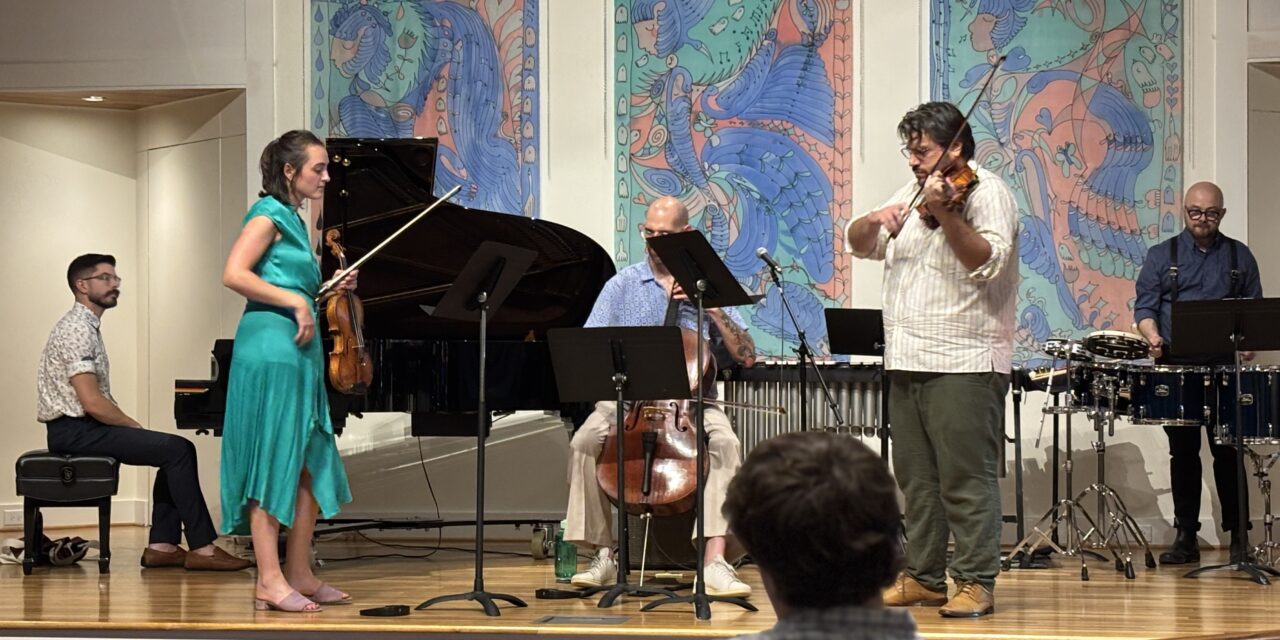
The pieces themselves were as deconstructed as the long and short hands of the clock. Wednesday and Thursday’s group of musicians included Devin Copfer on violin, Daniel Jacobs on viola and Dr. Timothy Ledger on piano, alongside Johnson and Demland on cello and percussion. Some pieces heavily focused on pizzicato, or plucking, on the strings without a bow to create the sounds naturally attributed to stringed instruments.
Within the order was a clear structure. After each new song was a trio of pieces of Harrison’s “Rhymes With Silver.” So, after Meier’s Pride flag-inspired composition, with Meier in the audience to watch the performance, Johnson began with “Prelude.” A score originally played live by famed cellist Yo-Yo Ma was in the hands and bow of Johnson, who played the first piece alone, with everyone else pushing towards the periphery of the stage.
From there, the Silver elements stretched from the smooth and romantic to the chaotic. Some sounded like the music expected at a traditional chamber event, by composers from hundreds of years ago and others, like “Fox Trot,” took the listener on a journey. With emphasized piano using a homemade octave bar by Ledger, it allowed the musician to play multiple notes at the same time that gave the song a haunting feeling. Almost a caricature of the music engrained in Harrison’s brain from the repetition of dance classes as a child.
Then there was “Celadon” by Yaz Lancaster, created specifically for the event. Celadon is a glaze used in ancient China, with the purpose of highlighting imperfections of pottery by covering the creation with a haze of jade. That meant the song itself, played with cello, violin and percussion, used the bow but was played faster, sometimes closer to the bridge, to give the notes a humming quality. It was almost like the mistakes of a beginner on the instruments, but done on purpose.
The final new composition of the night came from Demland himself. Inspired by the work of essayist Susan Stryker who wrote the line “Gender is a percussive symphony of automatism” in “Dungeon Intimacies: The Poetics of Transsexual Sadomasochism,” Demland wanted to know what that sounded like, using only percussive qualities of all five instruments. Demland set the song up by explaining the process of a percussionist. How new music enters their brain and they have to bring the notes to life with a myriad of options within the percussion family, which Demland needed two carloads to transport all of his instruments for Contrary Motion. That meant the other four were tasked with making their own percussion with their instruments.
That meant that the bows turned to mallets and the hollow bodies of the cello, violin and viola became the film. The only traditional stringed sounds came in short bursts as the song that took some getting used to, as intended. It came together with a precision unexpected from instruments transformed.
Throughout the entire evening, the backdrop of the performance were three large silk tapestries, created by artist Ursula Scheuer, who was front and center in the crowd. The 80 x 46 inch trio of art came from the beginning of Scheuer’s own transition. Each of the three transgender angels represent parts of herself. They include flowers, music notes, hearts and more.
For the final trio of Harrison works, Johnson spoke about Scheuer’s work and how the theme of transition played into the songs that closed the show. In Harrison’s “In Honor of Prince Kantemir,” the musicians played their Western created instruments in a song composed for Eastern instruments in a piece dedicated to a Roman prince that created his own Ottoman-inspired music.
When the program ended, there was applause and silence, almost to the point of awkwardness. For all of the power of the musicians’ work, the hush that followed the standing ovation allowed people to sit in it.
Contrary Motion’s program pushed forward their mission of the sound of Queer music. The group applauds Pride parades and bar events throughout the month in the program for the 2026 event, but their performance was a desire for a wider identity through sound. A sound that breaks through stereotypes of not only classical music but what is deemed mainstream LGBT+ music. After hearing Contrary Motion’s performances over the years, the answer to their mission’s question is seemingly endless.


