Simplifying the human brain is understandable. There are all those synapses and lobes. One of the sides is the artistic one and the other is the logical one, maybe? It is a confusing place up there. So, when considering a statement that reads something like “there are only two ways to think about this,” it is doing some heavy lifting. It is also likely wrong. With that said, it feels like it applies to Case Oats’ concert Thursday night at Rumba Cafe.
There are two ways to think about the Case Oats concert, in terms of attendance. The early thoughts in my cobweb-filled brain go to reading the room. After a short trip to the back patio to catch up on life with a dear friend, we walked into the venue proper and the crowd was sparse.
My brain immediately goes to guilt. Especially considering Case Oats’ “Last Missouri Exit” 2025 LP release. The debut album from the Chicagoland band popped up seemingly out of nowhere and took firm control of my listening habits. On the off occasion when it was tough to find something to listen to, Case Oats came up on shuffle and indecision ended. “Last Missouri Exit” is expert storytelling, with personality and bite.
Guilt connected to the cost of touring, the risks involved in going on the road and the courage to ignore all of that and put yourself out there, on stage. Quickly into the show, that guilt turned from the first way of thinking to the second. Guilt shifted from the musicians who traveled to Columbus for the start of Case Oats’ first headlining tour to the people who missed out on seeing it.
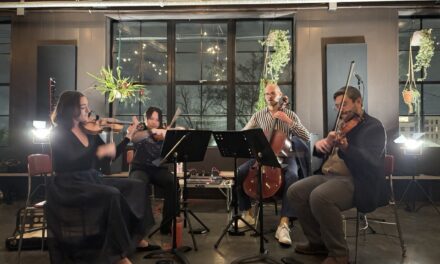
The start of the night laid in the hands, and guitar, of Henry True. Friend of the headlining band, True is a fellow Chicago musician who admitted early into the set that this was his first tour in seven years. On top of that, Thursday was True’s first show for a while. That never came across in the music.
True is a singer/songwriter who sings emotion-filled songs, with a voice that brings credibility to those feelings. Nothing felt forced or inauthentic. When the lyrics leave True’s mouth, they are not empty words that vanish into nothing. No, his voice billows. It rolled through Rumba Cafe.
Throughout the set, more arrived for the show. Each time, a streak of light stabbed through the entrance behind us. That tried to jar and distract the environment, but it couldn’t last with the songs coming from True on stage. Standing there and listening, which a few folks did with the rest sitting in stools around the perimeter of the small club, paired with closing ones eyes is dangerous for me. The acoustic-driven songs, combined with True’s voice, pushed me closer to full rest, which is not a good idea when standing up on a concrete floor.
At one point, while tuning, True gave a small peek into the DIY musician life when he shared a “Greatest Hits” CD as his lone merch item. Those CDs were burned onto disc the night before by True himself.
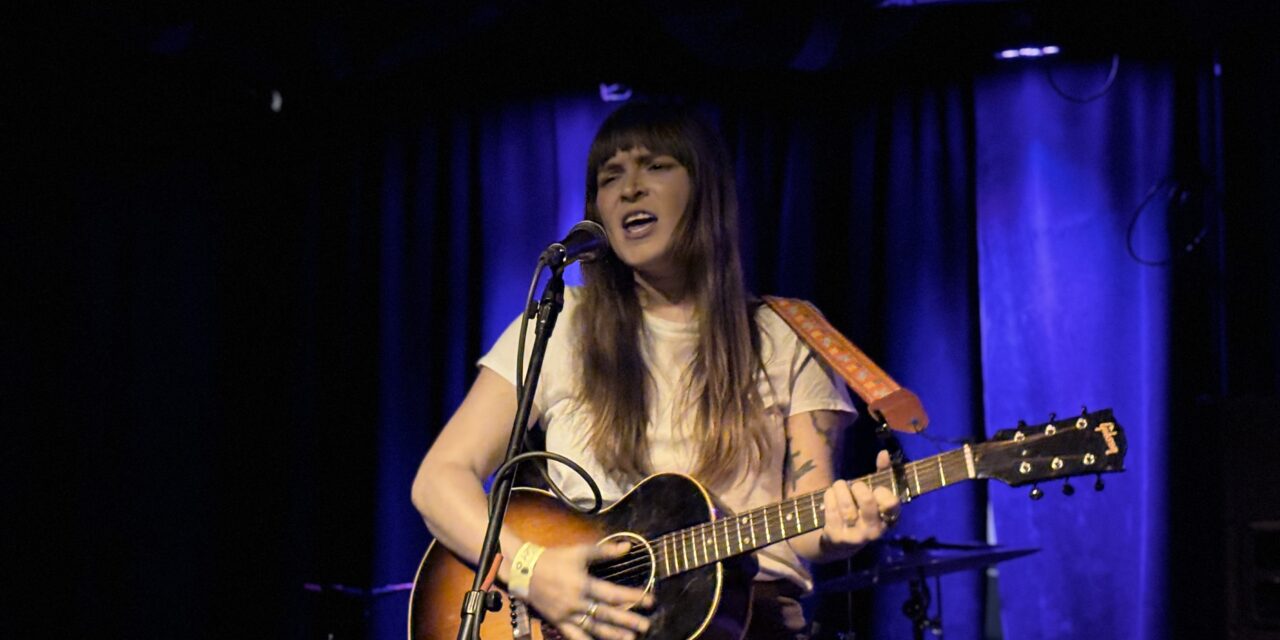
Closing out the weekday night was Case Oats, who brought a four-person touring band led by lead singer and songwriter Casey Gomez Walker. In support were Spencer Tweedy, who played drums and co-wrote songs, guitar player Max Subar and bassists Jason Ashworth. Now, on the debut LP from Case Oats, there is more instrumentation than what you hear at the concert. There is normally pedal steel, fiddle and more on “Last Missouri Exit” that did not travel for this tour, at least in Columbus.
Even so, that does not take away from the sound. Case Oats’ songs are well told stories. On the album, musicianship is great, but the focus lands mostly on the words of Gomez Walker and Tweedy. In-person, small adjustments to pace and freedom on Subar’s guitar playing elevates their songs.
Take “Nora” for instance. The chorus of the track features Gomez Walker singing “Nora” three times, where she stretches out the A and lifts it into the sky. On stage, Gomez Walker, Subar and Ashworth fit five into the same space, which puts a little more oomph into the song. In other songs, Subar’s guitar playing has more edge, and a twinge of grunge, as the jean jacket wearing guitar player seemingly slammed down on the strings.
Cast Oats’ setlist went through all 10 songs on “Last Missouri Exit” and three new tracks. In a feeble attempt to share about the show, Columbus Calling compared the songwriting and tracks to the legend Neil Young, which seems like a lofty comparison until you dive into Case Oats’ songs. Right off the bat was the song that carries most of that Neil Young attitude, and guitar playing, in “Hallelujah.”
Even though the mic was not working for the first few seconds (of both sets), “Hallelujah” starts with the title of the track, a brief pause of everything, then the line “You’re not his saving grace.” Right away, it sets up the premise of a no good, very bad, guy and the person who put up with too much for too long. After those first two lines, the guitar playing goes on a quick trip back to the 1970s on a few riffs. Then the storytelling aspect does not beat around the bush, an endearing quality of Gomez Walker’s songs.
“Cause baby, I adore you
And your mother does too
And your sister would break his fucking bones
And your daddy does adore you
And your brother does too
And you deserve the stars, the moon, and the sun”
With every track of the album going into the set, which Gomez Walker admitted at one point being all they had, there is no regret on missing a favorite song from the album. Personally, “Hallelujah” and “Wishing Stone,” my two favorites on the album, landed in the top four songs of the set, which made me happy.
Another positive note was a respectful crowd who did not talk throughout the set and got up from their stools around the edge of Rumba Cafe to stand up front, at the request of Gomez Walker. With the show at a smaller venue, there could be real dialogue between the band and crowd, although there was not much. That is the MO for a lot of Columbus shows, as told by the musicians themselves that night and at a multitude of previous events.
Normally not one to distract or bring attention to myself, I did ask about as local of a line as a Buckeye state resident could find. After “Tennessee,” when Gomez Walker called up those in attendance, I asked which Ohio town inspired the “Now he hides away in some tiny Ohio town, I’ve never been to.” While Gomez Walker did not remember, unfortunately. Although there is corn in the area, which narrows it down to being outside of Columbus (unless they were corn statues…).
The lyrics stretch from Jesus coming out of a cave to hockey and all things in-between. In “Kentucky Cave,” there is even a Brothers Karamazov reference, from the classic Russian author Fyodor Dostoevsky.
Two songs before that, Bitter Root Lake features “Crime and Punishment”-esque murder guilt. In the story, a couple tries to fly down to Mexico. As they cross a lake in Montana, they bring the plane down but ultimately land in the lake. The woman, caught in her seatbelt, drowned as the significant other went on the run after a failed attempt at saving her. Before getting to the chorus, which closes the song out, Gomez Walker sings lyrics that always stick out to me when I listen.
“Dreams of you still haunt me, I see you floating there
My love has never faded, I dream of your wet hair”
Before closing the night with two new tracks, Gomez Walker sang “Bluff,” which is the final track on the record and as she shared with the Columbus crowd, was the first song she ever wrote. It is no surprise then that the album made its rounds when it released in 2025 as one of the best in the genre. That first song she ever wrote turned into a full setlist of songs that come alive in the transition from the LP to a stage. In “Bluff,” only Gomez Walker performed, until Tweedy accompanied from the drum set vocally in a few parts.
Case Oats ended the evening with two new songs. Each of the three new songs still had the the writing style, but featured more energy musically. In the final song, listed on the setlist as “Wonderful Things,” had the three accompanying musicians close out the show with a bang. Tweedy, holding the drumsticks near their halfway point, was constant energy while Subar and Ashworth elevated as the song built up towards the peak of its crescendo.
During that climb, Gomez Walker repeated the same line for what could have been a minute or 10 minutes with how much it grabbed attention. Walker sang “I still dream wonderful things,” repeatedly. It grew louder and louder as the singer/songwriter reminded herself that it is ok to have dreams at a time when everything seems awful. Then, for the final handful of lines, Case Oats brought the intensity down, as Walker herself moved closer to the ground with each iteration. The show ended with Gomez Walker sitting on the floor, thanking everyone for coming to the concert.
There are two ways to think about that Case Oats show. The best choice is that if you were there to see it, you were one of the lucky ones. It might not be so easy to get tickets the next time Case Oats comes to town.