

Photo by Emma Stefanoff
The Wastemen band is rounding up on their second album entitled Wastemen II. It’s full of psychedelic sound waves and baselines that are pensive and frankly existential. I had the opportunity to chat with the introspective brain behind this sound, Billy Buehl. Now Billy is the average Ohio resident: grew up in a suburban town, went to school, has a day job… all is average except the music. When asked what Billy would call himself, he refuses the title of musician, he says “I’m just a guy.” “I’m really bad actually. I’m bad at guitar, I don’t understand anything to do with music theory, it’s just a fun thing to do with friends.” The other two members, Lorenzo Fava and Nate Hervey, are “actual musicians.” One was in orchestra, the other well trained in their instrument.
The sound of this album is different than the previous. Billy mentioned that when they first started the band he was more into “grudge punk bands”. But as he’s gotten older, he has leaned more into bands like Massive Attack. Citing the song “Paradise Circuit” as an example, you hear all of the instruments. “The drums are very contained. You can hear all these percussive elements.” He said he liked the song and that “you can really hear her voice, it’s so angelic”. You can see the separation of different instruments as their discography progresses.
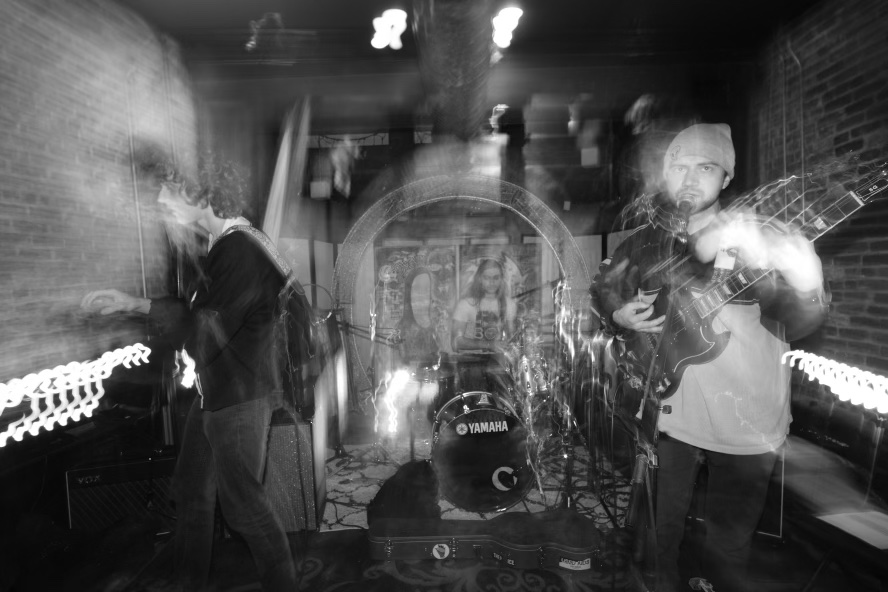
Photo by @myadultswim on Instagram
Wastemen II was, as Billy put it, “geographically not together.” Recording, producing and even writing was done in a variety of locations, including his bedroom. Gives a real meaning to bedroom pop, if I do say, though Wastemen is certainly not the lo-fi vibe you might glean off Jack Stauber or anyone on the Bedroom Pop Spotify playlist.
It was also different given that it was, according to him, “geographically different.” Songs were written at a different pace, perfected in different timing. The order even fell into place, “It happened over such a long period of time [that] it kinda just fell together, the order kinda changed. It wasn’t a thoroughly planned out thing,” Billy explained. He concluded that “it was finished in a way that made sense. I had always intended it to be that way but I didn’t plan it out.”
The musicians you will hear on this album are obviously Billy Buehl, Lorenzo Fava (on drums), Nate Hervey (on bass and synth). Billy also called in other friends: Twan (Anthony Stanzi) who took the bass on a couple of songs, Alex Scalzo on the keys and Mike Madgar from King Buu. “It was kind of a mess, and I just pulled people in when there needed to be parts,” Billy explained. When asked whose album this was Billy explained that, “this was a very intimate album,” and indeed it was. You are taken through an anthology of elements, from samples to a beloved cover.
Speaking of samples, “Saturn”, song two on the album, features a recording of Marvin Heemeyer known best for “Killdozer”. Now I had no idea what a Killdozer was, but Billy explained it as this man who built a tank because he was so bitter about a zoning dispute. He said that he went insane in the process. “It’s funny and sad… you really pity him, ‘cause when you’re alone for a really long time you start to lose any sense of proportion of anything, you start to lose your mind.” Apparently, there are hundreds of tapes that Heemeyer made, hours and hours of isolationist spiels. Billy said “I kinda just picked a random part and I imagine he’s just spouting off about his grievances with the city… it’s just a local town it doesn’t really matter, he’s just become obsessed about it.” When asked if he cared enough about any place to bulldoze, to go crazy over, he chose the park we were walking in, Lakewood Park. I can see why he would care so much about that park. It was sunny, slightly windy with summer breeze. There were families out barbecuing by the pavilion, people doing yoga in small groups, couples of people walking all around. There was laughter and loud animated talking, kids on skateboards, religious rites giving out free chocolate, a real emblem of whatever realistic summer utopia one might be trying to conjure.
The cover on the album is “The Rip” by Portishead. “It’s such a better song, an actual musician song” he said. “It’s the most beautiful song ever.” “I tried to emulate [it] as closely as possible and I was so worried it would be a horrible rendition,” he explained. He said he listened to the song five times a day for two years. Honestly, as a person who hadn’t heard the song before, and had to be explained what Portishead was… I thought it was a damn good cover.
When asked about influences for the album Billy explained the importance of structure. He told me to imagine it like a rollercoaster, how the song flows, and that many of the songs structures were based on the Portishead song. Billy said many times that he wasn’t a musician, didn’t care about music theory or any regulations in the traditional sense. I would argue that he just looks at it in a different way. He sees structure, the baseline, the bones of a composition. I would also argue that’s what makes the music so great, it doesn’t have to follow compositional rules and regulations set in stone from the 13th century. He says this kind of structure “just makes sense.” When explaining his influences, he explained his interpretation of derivative creations and creative creations. “Something derivative is stealing from one or two sources but something creative is stealing from 5 or 6, it’s too vague. It’s just a blend.”
There were many songs that I loved on this album. “The Satellite” was like being on the highway at night anticipating a crash, but it never ended up happening. “The Fatalist” was funky in a discordant way. “God Speaks the Truth” pulled in such an uncomforting yet listenable sample.
“The Egoist” seemed to me so chilling, monotone even. It has small discordant picking styles. You can even hear the breath being used as its own instrument. Billy explained that the styles were pulled from “whiny” artists Eliot Smith and Nick Drake, “whiny” used as a descriptor in only the most endearing ways. He said that he was trying to emulate that “whole obsession with locking yourself in your room and trying to make it ideal and this whole confession of everything you have to say. And then you realize no one’s even listening.” He says that “everyone’s got this confession,” and that analyzing the meanings behind his own confessions “is the quickest way to lose your mind. I wouldn’t recommend it.”
The creation of the recorded album was truly interesting, but for those who crave a live experience to lose themselves in, the Wastemen should also be their go-to. I have seen them in various spaces and house or venue, or dingy “venue”, they should be a go to. Building sound outside of the comfort of computer editing can be wildly different than the live interpretation. Though some bands seem to preform two types of sound: the edited and the live, somehow Wastemen has managed to manipulate both manners of performance to resemble the same sound. Billy explained to me how he produces his individual sound live. For the pedal whores in the room Billy filled me in on all the secret mechanisms that go into this alienesc sound, and in actuality, it’s very simple. One guitar pedal and one vocal pedal. “It’s this stupid overdrive pedal my friend gave me in high school,” he described it as having a demon face on it. “I kinda turn the tone all the way up and the gain all the way down,” he says it produces this shrill sharp sound. He also uses a vocal pedal, a TC Helicon. We deliberated that it was for damage control.
All in all, Billy is a humble guy. He works a good day job and just wants to create music. He pours his soul into the little details, the structure, the emblems you might not notice. He produces a sound worthwhile. I hope if you got to the end of this, you can take away the thought that went into this album. It’s definitely worth a listen or two.
Billy’s Local Recs:
- Dandelion Hunter
- Tetnis
- Villagerrr
- Golomb
- Shrine


