
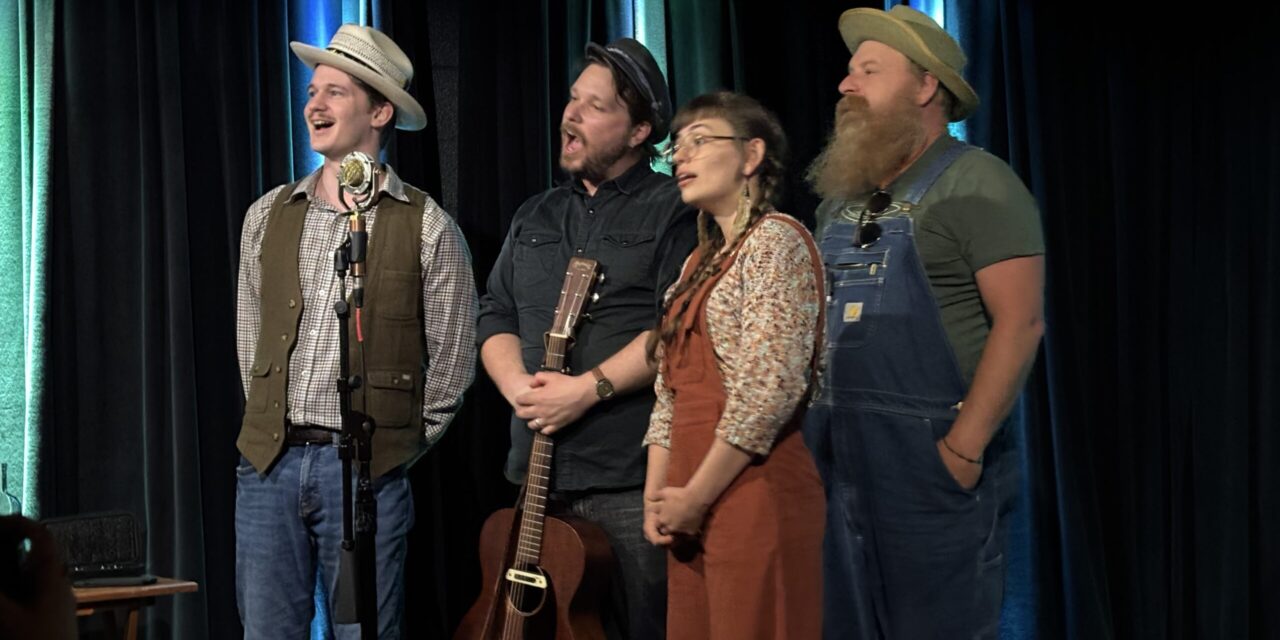
There is something sacred about live music. This is not some Nicole Kidman movie theatre ploy to guilt people into going to a concert, but going to a show brings people together, unified in a singular message. Regardless of the road that someone traveled to get to the venue, it is an all too important equalizer. Thursday night at Natalie’s, a trio of acts on the Folk Around and Find Out tour played to a sold out room with a focus on struggle and family.
With that sanctity comes expectations, and in many ways the concert broke them. First, my familiarity with Natalie’s Grandview does not extend beyond one concert I attended a couple years ago. So, when I heard that the concert sold out, what I envisioned did not match reality. Instead of a large standing room, with a gaggle of bodies building up a group musk while legs broke down over the course of three hours. Instead, the Jordan Smart, Willy Tea Taylor and Jodi Jones concert was played in a restaurant.
Sitting at any concert is a pleasant surprise. Even more so as revolutions around the sun increase, but the shock at Natalie’s was jarring, at first. Call it lack of preparation, which is exactly what it was, but not knowing it will happen takes some getting used to. Listen to any of the three acts, all in your face folk music where no topic is off the table, and the expectation is minimalism.
All three acts, comprising of four total musicians, did not come in with drum sets or electric guitars. It was folk music in its intimate, and sometimes traditional, form. The music elicits thoughts of traveling troubadours playing whatever stage or street corner is available, not QR codes to order an espresso martini directly to your seat, with Apple Pay.
Even so, in hindsight the connected tables and strangers sitting next to strangers added to the idea of a family get together. That was the feeling on Thursday night.
Up first was Jodi Jones, a Western Pennsylvania singer/songwriter who plays folk in its purest form. Alongside banjo player Brendan Macie, the duo stood in front of the retro microphone and performed songs rooted in Appalachia. Coming from an old coal town, Jones’ songs covered the plight of workers, credit card debt and how things in the world are just bad in general.
Now, the usual argument for “political” music is that live concerts are an escape from real world problems. That notion itself is a product of capitalism to avoid the truth and keep spending. When Jones played the songs, that unification in the crowd was more reassuring than worrisome. The idea that everyone feels similarly, even if that was not the case for the sold out audience, is more helpful than hurtful.
Together on stage, Jones and Macie harmonize well together. Jones sings with a voice that demands your attention while Macie lined Jones’ smoothly in the background. Sometimes there were even more to add to the sound.
On the second song of the night, Jones brought up Columbus-based married country duo Wesley and Caroline Crow, who play under the name The Hen and the Crow up to the stage to sing backup on “Bread and Roses.” While Jones is not from the area, the full-time musician heralded the show as the closest she ever performed to her home one state away. Bringing The Hen and the Crow up was the first in a long line of family references over the nearly three hours of music.
Jones also talked about the pitfall of becoming viral online, or as she put it “like winning the lottery but the prize is really bad.” That came before “American Dream,” a track that starts with “don’t talk to me about bootstraps when I ain’t got no shoes.”
The couple that plays music under the Sugaree String Society moniker performed all of Jones’ songs in the opening set. In true traveler style, Jones brought handmade merchandise in a decorative suitcase that included shirts, original prints and more. Jones’ performance was not an opening set as much as it was a giant leap for her personally. This tour marked the first for Jones after she quit her regular job to pursue music as a career. That faith lined the emotion of her performance and what followed.
Up next was Willy Tea Taylor, a California-raised man of the road. Taylor stepped up to the mic in his blue overalls, cap, round sunglasses and a beard so full and rounded that it looked more like a lion’s mane. Attached to the mic stand was a painting of Robert Duvall. The edition of the actor with a cowboy hat, gruff facial hair and demeanor from generations past.
Early in the set, Taylor dedicated his show to the recently passed actor, and the songs that followed mirrored the sometimes soft-spoken Duvall. A quietness that is not for lack of words to say but knowing when to use them. That idea outlined a set full of songs about his van, an a cappella ode to his former dog in “Damn Good Dog” and two thirds of a set of tracks about growing up around Bakersfield, California. That does not mean he kept things brief, as Taylor showed he is a tried and true storyteller with tales about suspicious Red Roof Inns, the name of his van and his friendship with Smart.
While Jones’ songs brought up the importance of picketing and the fight for common decency, Taylor sang about his experiences.
For example, the soon-to-be trilogy of songs about growing up with grandmother. A woman who drank from a cup of whiskey all day, which is the first time Taylor drank when he mistakenly took a swig of his grandma’s “Pepsi.” In “Big Jim’s Guitar,” the recently turned 50 folk singer sang about his grandmother’s boyfriend who taught Taylor how to play. Taylor played the track on his own four-string guitar, and it created images of Big Jim playing for his grandma all night in their home each night. Taylor followed that with a track about how his grandmother did not want to be buried where she lived, in Bakersfield.
How Taylor sang sometimes felt like a piece of a Tom Wait-esque gravel, but without the additional theatrics. Taylor swayed behind the microphone to add effect and he whistled. At one point, without any preparation, he told the crowd to join him in whistling a part of a song. What came back to him was an aviary of sound.
Taylor’s biographical set, while the dog he recently got on the road sat in his van with plenty of ventilation and fans, combined perfectly with Jones’ to lead into Jordan Smart’s closing songs.
Thursday was the third time I have had the pleasure of seeing Smart perform live, but it was different than the times before. First, Smart opened for country singer Willi Carlisle down at Southgate Revival House in Northern Kentucky. Smart stole the show, which is tough to do with someone as animated as Carlisle. With only an acoustic guitar and harmonica, Smart played songs that made people laugh, sing and think.
The second time, at the 2025 Nelsonville Music Festival, was a lot of the same. That time, at the creekside stage, Smart played in front of a large group of seated festival goers. Of the many sets seen at that stage over two of the three festival days, Smart is the only one that garnered a full standing ovation.
At Natalie’s, Smart still played his more popular songs like “Confessions of a CEO,” where a healthcare company CEO rejoices in the death of people he insures. There was also “Pickle Song,” a track about hatred towards immigrants and anyone different than yourself. Smart still sang songs that grabbed people by the face and didn’t let go, but that overarching theme of family made the night more intimate. Originally from Ohio, Smart moved away, came back and then set roots just outside of Cincinnati, in Kentucky. That meant the sold out Columbus leg of the tour featured a crowd that consisted of a lot of Smart’s family.
Smart’s mom, fiancee, daughter, grandmother, cousins and more lined the audience. His grandma even received an apology mid song when Smart began talking about a dime bag. That family presence also meant that songs like “Apple Don’t Fall,” about growing up with alcoholic parents and the fear of passing it down to his daughter and a new track about strong women fighting through injustice carried a more emotion. Which says a lot considering how much emotion Smart can already pull out of an audience. This time, those feelings were equal on his side of the room.
Many times throughout Smart’s set, the songwriter who does not seem to have any issues coming up with words for songs that get stuck in your head was struggling with his words. They were not set-stopping moments, but times when his eyes watered and he did his best to pause and compose himself before moving on.
Along with the two accompanying acts, Smart also told stories between songs. For people that do not like it when musicians do that, do not go to a folk show. Each time, the stories enhanced what would follow. Smart talked about wanting to get a song about John Prine to the legendary singer. That started a back and forth with patrons in the crowd. The first was a man who lived outside of Chicago where Prine was once his mail carrier. Then a retired mail worker received applause for her work.
Even though the lights were down in the audience, those connections did not have the usual invisible wall of “the performers are up there and everyone else is down here.” There were still things yelled that should be ignored, because there are always folks who want to be heard in the crowd, the true moments of interaction shined through. It created that family dinner table environment.
Then it all came to an end. Smart invited Taylor, Jones and Macie up to the stage to sing on “Who Would Jesus Bomb?” It is the track that garnered the most attention online for Smart, and is a crowd pleaser, but Taylor was absent, at first. Smart warned everyone that Taylor was a flight risk early on in the night, which is to be expected from someone who calls Earth his hometown. In all reality, Taylor was likely playing with his dog.
Near the end of the night, Smart kept the song going when Taylor reappeared. All four stood on stage and belted out the chorus of the track. It felt like family.


